it
it
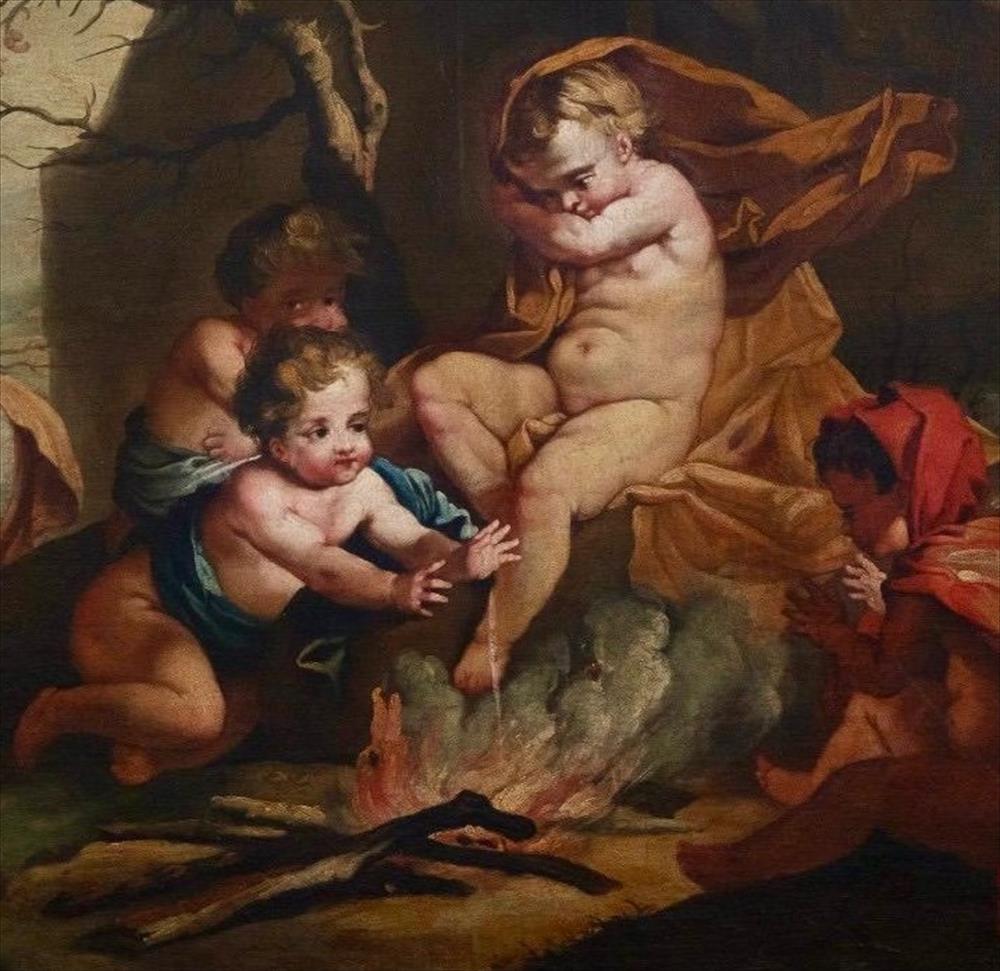
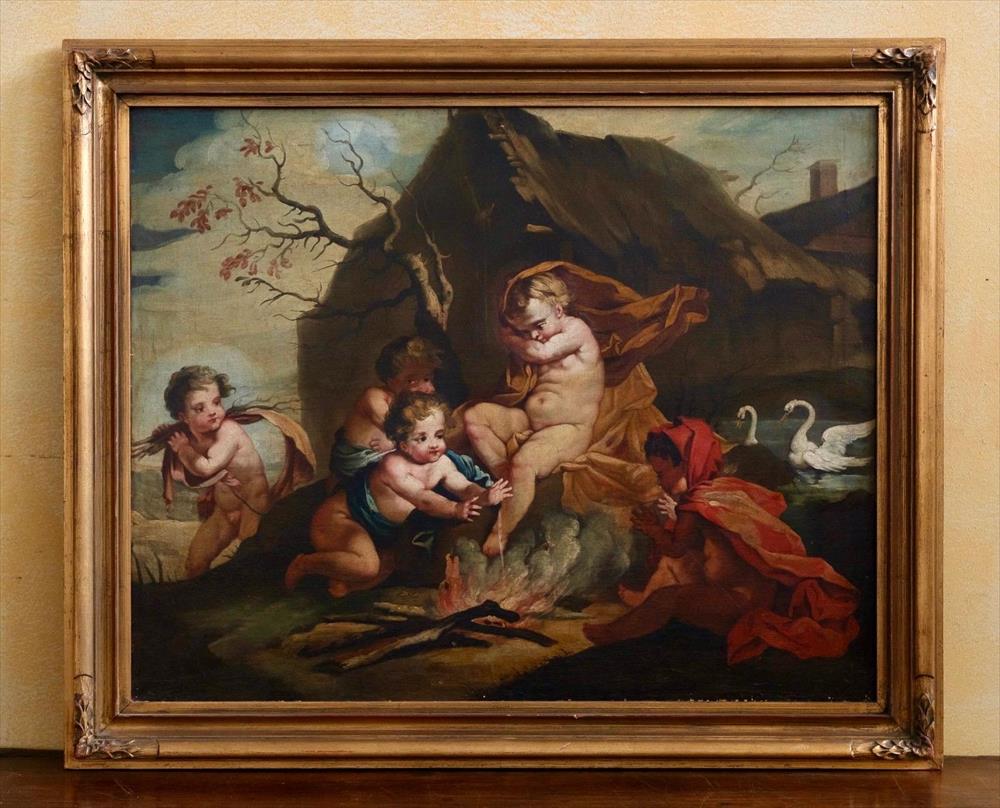
Putti, fire, season. A scene that shows rather than explains.
The subject is immediately clear: Winter, expressed through a group of putti gathered around a fire in an open setting.
There is no narrative construction, just a simple situation.
One warms his hands, another wraps himself in a drapery, while from the left a putto approaches carrying a bundle of firewood. The fire becomes the physical and visual center of the scene, and everything is arranged around it.
The rest is defined by a few well-placed elements.
A rustic hut closes the background, giving structure to the space. On either side, the landscape opens up: a bare tree and, further back, water with two swans. Nothing more is needed to recognize the season.
The scene is not described, it is suggested.
The cold is not shown directly, but it is understood through gestures — in the hunched shoulders, the closeness to the fire, the way the bodies gather.
The composition holds because of this.
It is not meant to be read in parts, but as a whole that closes around a precise point. The fire is not just a narrative detail; it organizes everything.
Light follows the same logic.
It remains even across the landscape, while concentrating on the figures, where the warmth of the fire introduces a denser tone on skin and drapery.
Color is restrained.
Earth tones, ochres, muted blues. Then the red, which does not dominate but stabilizes the balance and prevents the scene from becoming too cold.
From a stylistic point of view, the painting belongs to the Italian tradition between the late 17th and early 18th century, within a North-Central context influenced by Emilian and Roman culture. The treatment of the putti, the measured composition, and the overall tone relate to the classicizing line derived from Albani, widely used in cabinet paintings and seasonal series.
Here, however, everything is simplified.
There is no excess decoration — just a scene that works because it is held together with control, without relying on effect.
Condition
Surface clearly readable, with age-consistent wear. Later frame.
Conclusion
A composition built around a clear center, stable and balanced without excess.
- Material: Oil on canvas
- Size: cm 89 x 71
- Condition: Tobe restored
- Period: Late 17th century /Early 18th century
- State: Optimal conditions