An image, a decision, and the limits of control
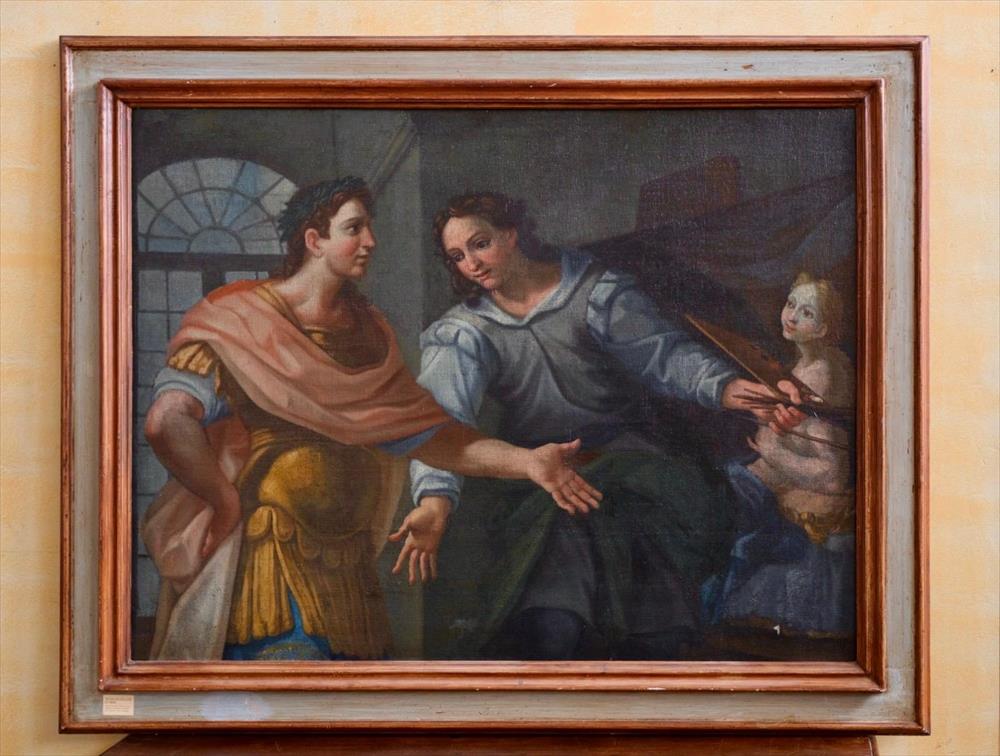
A large oil on canvas depicting a classical subject centered on the relationship between Alexander the Great and the painter Apelles.
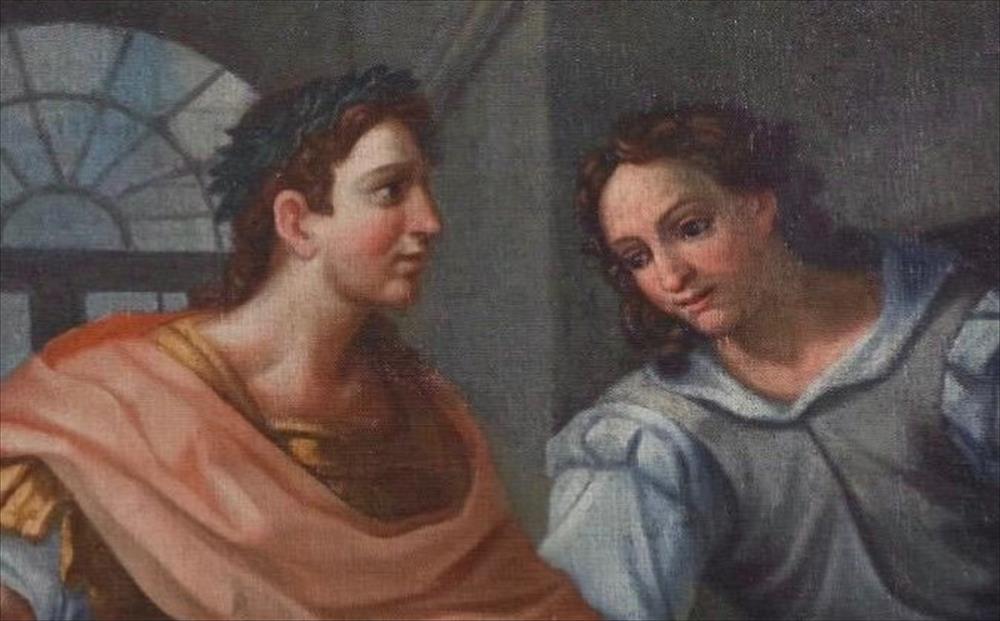
The scene is clearly structured. On the left, Alexander — identifiable by his laurel crown and armor — steps into the painter’s space and addresses him with a measured gesture. It is not an act of authority, but a controlled exchange.
At the center, Apelles pauses his work, palette in hand. His position is steady and composed, without visible submission. The interaction does not unfold on a strictly hierarchical level.
On the right appears the portrait of Campaspe, already completed. She is not physically present — only her image remains, and that is where the scene is resolved.
According to tradition, Alexander had commissioned Apelles to paint his favorite. During the process, the painter fell in love with her, and Alexander became aware of it. Not through words, but through the way the portrait had been made — the attention, the time, the intensity of the result.
At that point, Alexander has full control of the situation. He can stop the work, reclaim the painting, reassert his authority without resistance.
He chooses not to.
Because he understands that nothing would be undone. What has happened is not an action, but a shift. The painting makes it visible: Campaspe is no longer only a private presence, but an image that now exists beyond his direct control.
Alexander’s decision comes from this awareness. He does not react, does not force the situation, does not attempt to reverse it. He maintains his position without needing to demonstrate it.
This is not generosity in a simple sense.
It is clarity.
The composition is compact, built on a few well-defined figures placed entirely in the foreground. Light is even and controlled, used to clarify rather than dramatize. Color follows the same approach, with restrained tones and soft transitions.
From a stylistic perspective, the painting belongs to the late 18th to early 19th century, within an Italian context shaped by a neoclassical sensibility that looks back to the Renaissance. Drawing is clear, structure is ordered, and the scene is designed to be immediately readable.
Condition
Surface clearly readable, with age-consistent wear. Later frame.
Conclusion
This is a painting built on a precise moment rather than an event.
Everything is defined through the relationship between the figures.
 it
it