it
it
From private act to public consequence: a Baroque scene built on tension and reaction
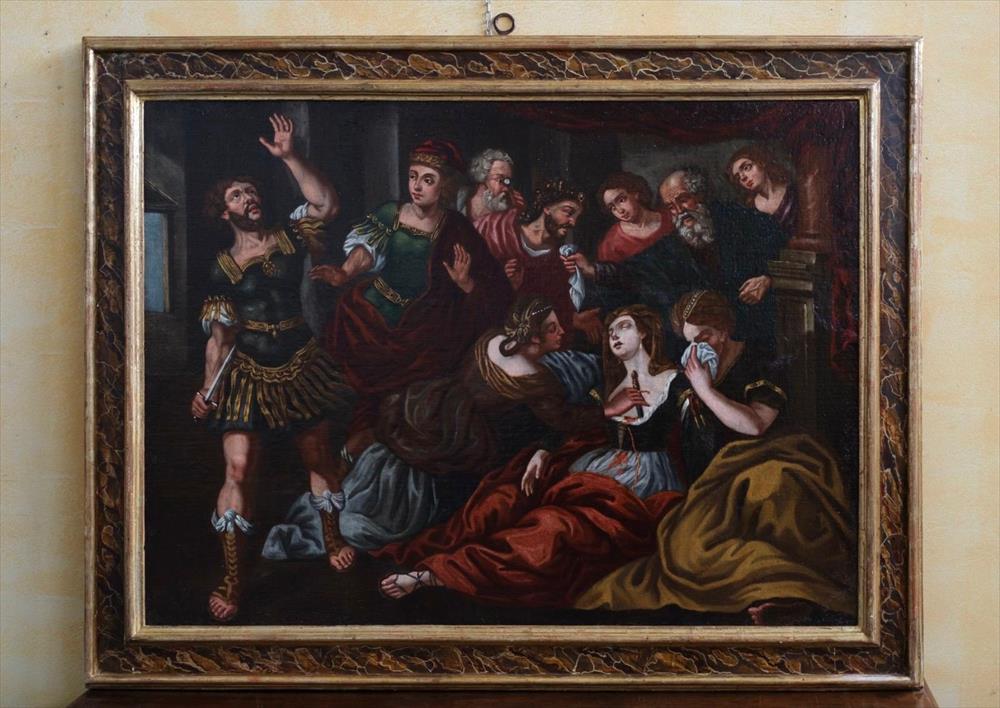
Death of Lucretia – oil on canvas, 17th century
Lombard school
This painting presents one of the most charged subjects of Roman history.
Lucretia, after being violated, takes her own life to preserve her honor.
According to tradition, this act would lead to the fall of the monarchy and the birth of the Roman Republic.
The scene captures the moment just after the act.
The central figure is already collapsing — pale, supported, the dagger still visible.
Around her, the composition is built through reaction.
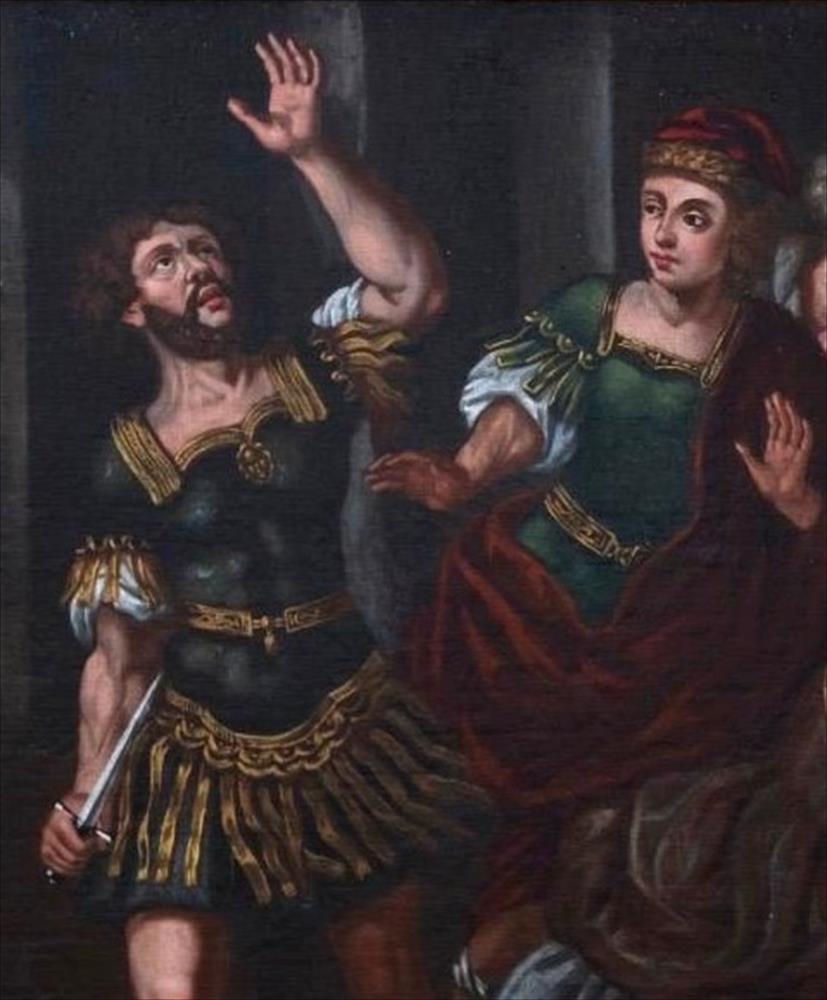
On the left, an armed figure raises his hand.
This is not only an emotional gesture, but a declarative one — the transition from private tragedy to public consequence.
On the right, female figures withdraw into grief.
Their gestures are contained, internal.
The painting operates on these two levels:
action and aftermath
political consequence and domestic response
The composition is compact.
Figures occupy the space without dispersion.
The background remains dark, concentrating attention on bodies, faces, and drapery.
Light is selective.
It defines hierarchy rather than atmosphere.
It isolates the central figure, activates whites and reds, and leaves the rest in shadow.
From a stylistic perspective, the work belongs to the Lombard painting tradition of the 17th century.
The scene is conceived almost as a staged composition:
close figures, explicit gestures, direct narration.
It does not aim at idealization.
It focuses on the event.
Rather than aligning with major names, the painting is best understood within the context of workshop production and regional masters active in Lombardy, capable of translating historical subjects into visually effective compositions.
Condition
Antique work with a non-original frame.
The pictorial surface remains generally readable, with signs of age consistent with its period.
Overall, this is a painting built around transition.
It does not simply depict an act.
It shows what that act generates.
It holds the moment where history begins.
- Material: Oil on canvas
- Size: cm 130 x 95
- Condition: Restored
- Period: 17th century
- Style: Baroque
- State: Optimal conditions