it
it
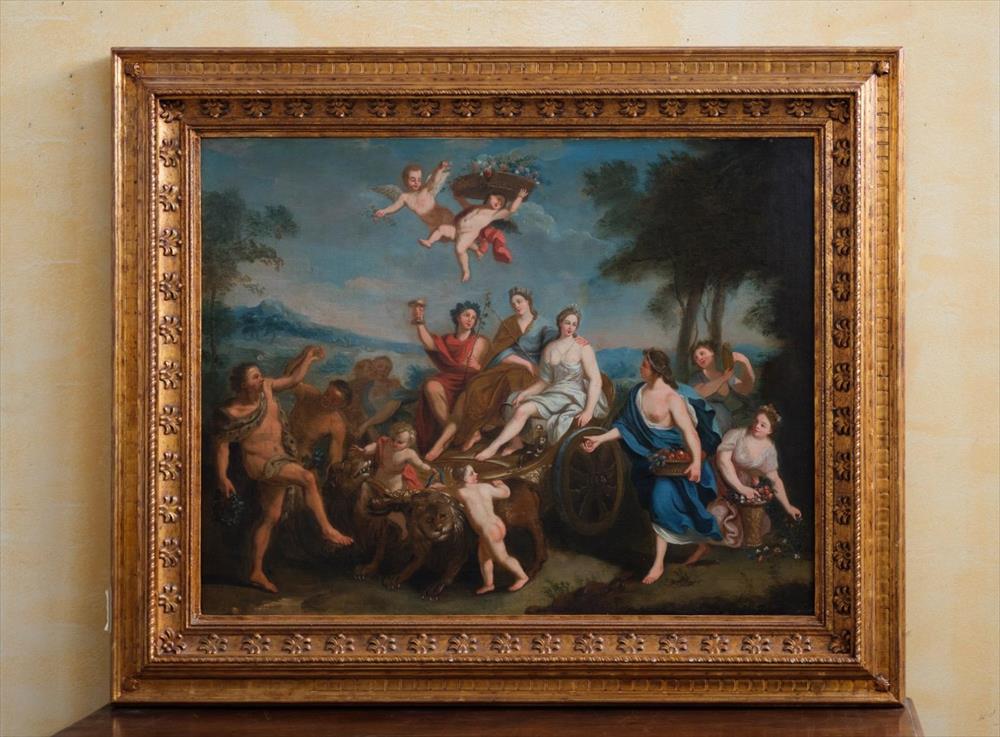
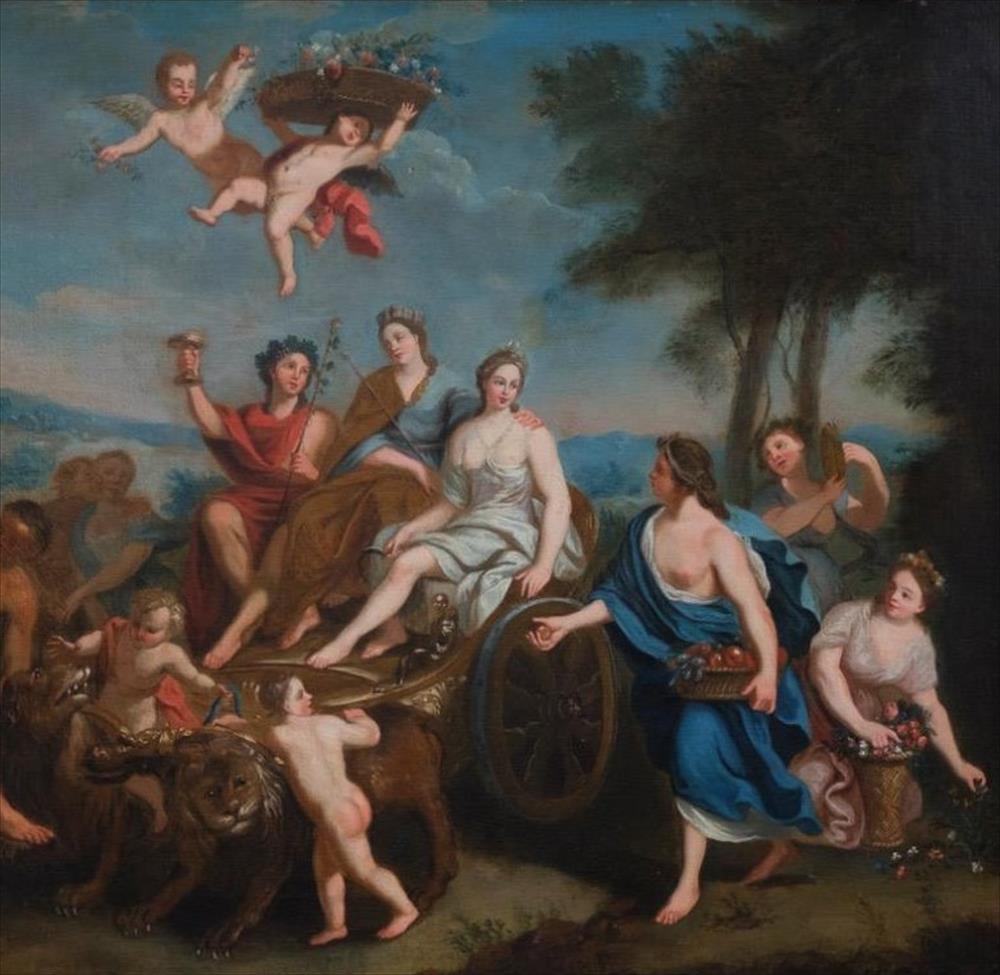
A mythological scene built like a procession, where everything moves forward without breaks, in a continuous rhythm.
At the center of the composition is Bacchus’ chariot, drawn by felines rendered with leonine features.
This element defines the subject immediately: the god of wine and Ariadne, now fully received at his side, advance together in a setting of celebration and abundance.
The story comes from classical mythology.
Ariadne, abandoned by Theseus after helping him escape the Labyrinth, is found by Bacchus, who takes her with him and places her within a different order. In painting, this moment becomes a triumph: not the loss, but the transition.
Bacchus raises his cup and moves with the procession. Ariadne sits beside him, already settled into her new role. There is no separation between the central figures and the rest of the scene: everything works together.
The eye moves easily across the surface.
It starts from the putti above, moves down toward the chariot, passes through the animals, and continues toward the lateral figures. The putti are not decorative: they connect the upper space with the procession below, linking sky and scene.
On the right, the female figures introduce a more grounded rhythm: one carries a basket of fruit, another plays cymbals, another gathers flowers. These are not isolated details. They are clear signs—abundance, fertility, continuity.
The same logic applies to the details.
Grapes, fruit, animals, simple gestures. Everything contributes to a scene that holds together on its own, without relying on dramatic effects.
Light is diffused and supports the scene without strong contrasts.
It holds figures, landscape, and sky together. The colors follow the same approach: light flesh tones, blues and reds in the garments, greens and soft blues in the background.
Stylistically, the painting belongs to early 18th-century Italian decorative painting, at a moment when the weight of the Baroque softens into a more open and narrative approach, close to developments in Venetian and Roman circles.
The scale and composition suggest a clear function: a painting designed to work with the wall and lighten the space, rather than stand alone as an isolated image.
Condition: the painted surface is clear and legible. Later frame.
This is a painting built on continuous movement.
It does not stop on a single point.
It draws you through it, step by step.
- Material: Oil on canvas
- Size: cm 118 x 93
- Condition: Restored
- Period: Prima metà del '700
- Style: Rococò
- State: Optimal conditions