it
it
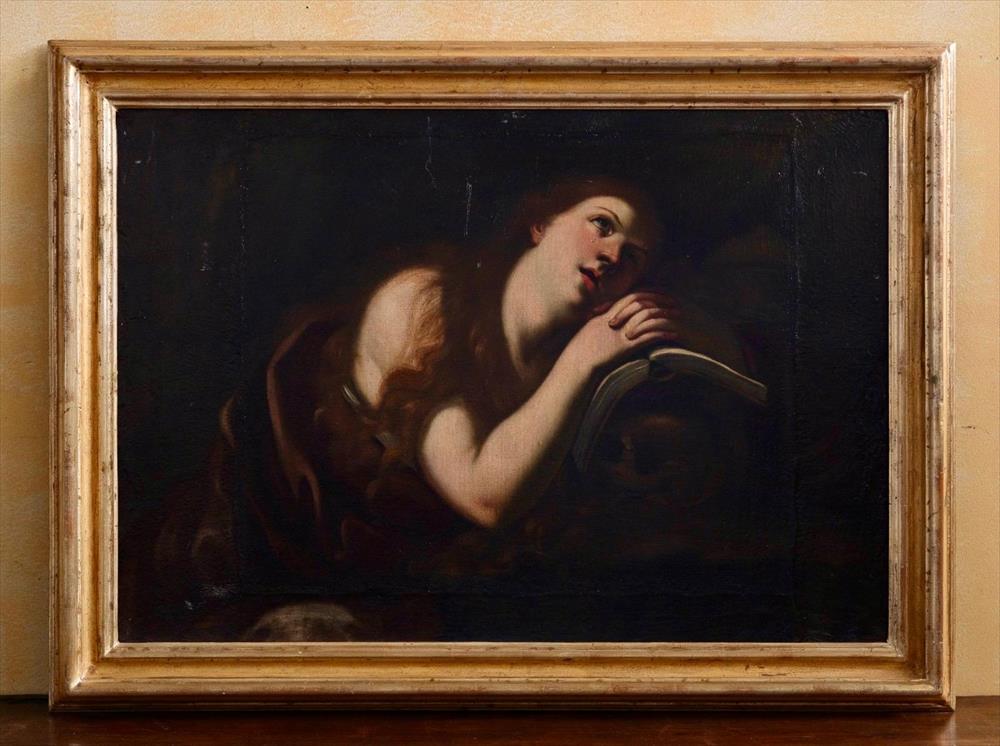
Penitent Magdalene – oil on canvas, 17th century
Italian school, with affinities to the Bolognese tradition
Oil on canvas (104 × 72 cm), built around a single figure set within a closed space, where everything is reduced to what is strictly necessary.
There is no narrative here.
What remains is a suspended moment.
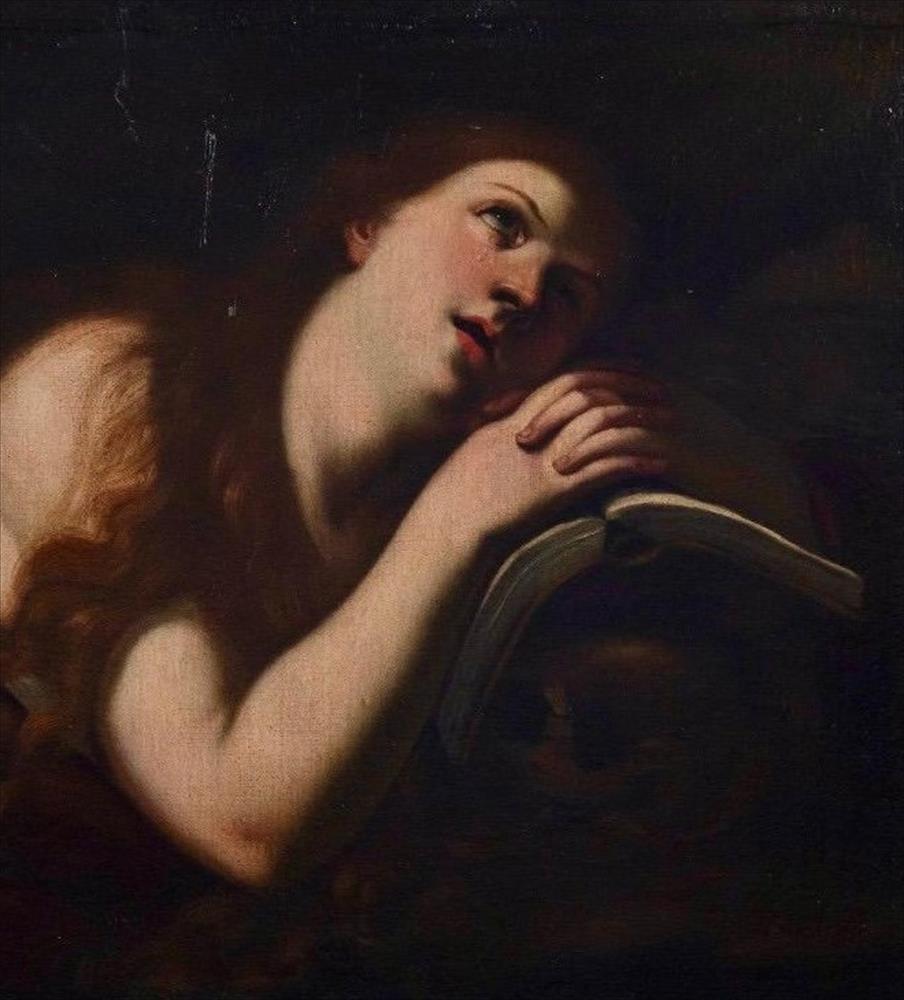
The Magdalene leans over an open book, her body slightly inclined forward, her hands resting quietly. Her gaze lifts upward, but does not meet the viewer — it moves elsewhere, as if following something already beyond the scene.
This is not a pose, but a state.
The book introduces the idea of meditation, yet it stays in the background. It does not lead the scene; it supports it.
Only on closer inspection does another element appear, almost lost in shadow: a skull. It does not assert itself or demand attention. It remains there, accompanying the figure, introducing the presence of time without breaking the stillness.
Light enters from the side, low and controlled.
It does not illuminate so much as reveal.
It touches the face, moves across the arms, and fades into darkness without sharp contrasts. It does not cut through the scene; it holds it together.
This is where the painting finds its strength.
The hair is built through fine touches that catch the light without forming a solid mass.
The flesh tones remain smooth and continuous, without harsh transitions.
The hands, resting on the book, are not arranged — they carry a real, quiet weight.
These are small details, but they define the presence of the work.
The composition operates through reduction: few elements, a restrained palette, a minimal gesture. Nothing is added. Everything unnecessary is removed.
From a stylistic point of view, the painting belongs to 17th-century Italian art, within a Bolognese context, where figures are constructed through balance and measure rather than dramatic emphasis.
This is not a theatrical Magdalene.
It is a restrained presence.
The scale suggests a work intended for a more intimate setting, where the distance between viewer and image is reduced.
Condition: the painted surface is clear and legible, with age-consistent patina. Later frame.
This is not a painting that works from afar.
It asks to be approached.
And when you take the time to look at it, it does not impose itself —
it remains.
- Material: Oil on canvas
- Size: cm 104 x 72
- Condition: Restored
- Period: 17th century
- Style: Baroque
- State: Optimal conditions