it
it
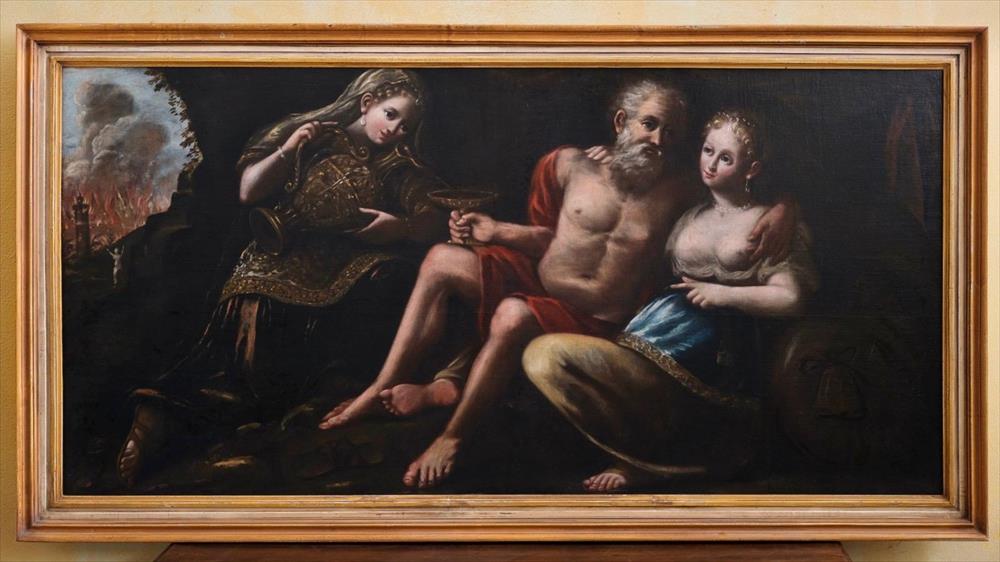
A biblical scene built on two connected moments: what has ended and what must continue.
The painting shows Lot with his daughters after the destruction of Sodom. According to the Book of Genesis, the two young women believe they are the last survivors, with no future and no possibility of continuation. From that conviction comes their decision: they make their father drink until he loses awareness, then move closer.
This is not seduction in any refined sense.
It is a direct, necessary act.
They support him, keep him within the situation, and guide what is happening. The intention is clear: to obtain a lineage, to ensure that something continues.
The painting holds this moment without dispersing it.
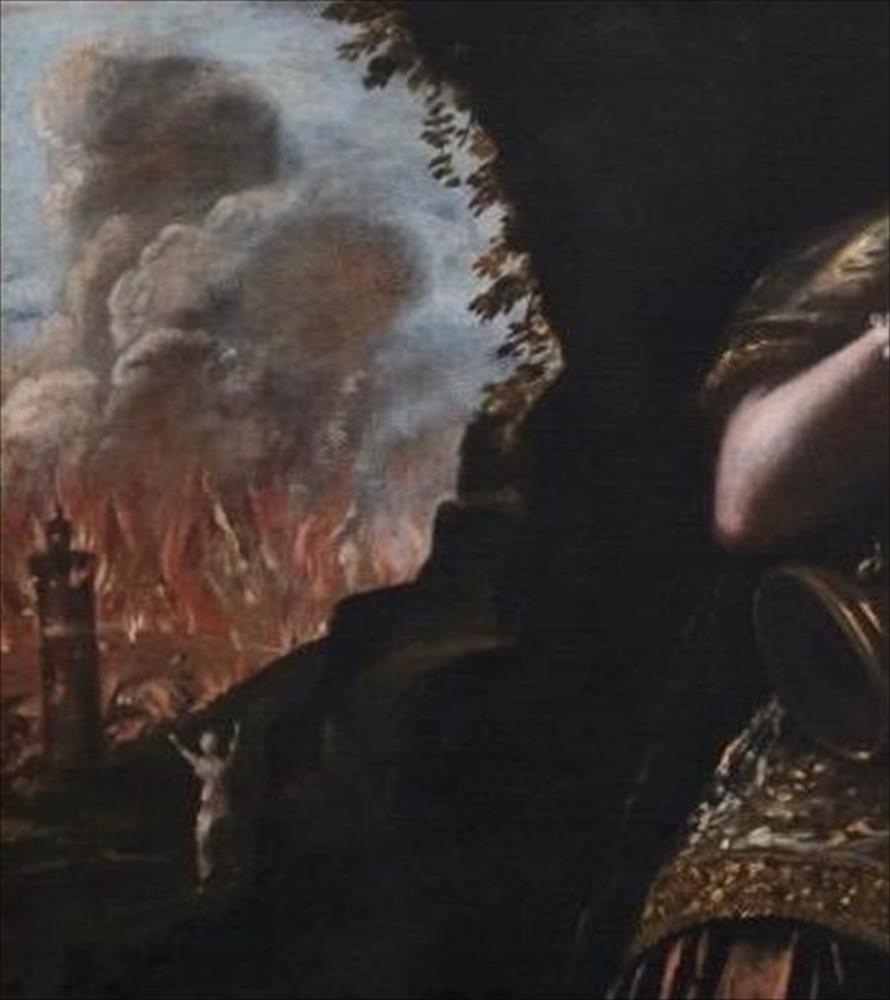
In the background, on the left, the city is still burning. Flames rise compactly, smoke closes the space, and among the ruins a pale figure appears, isolated: Lot’s wife, already turned into a pillar of salt. A small but decisive detail that marks what has been lost.
In the foreground, everything gathers around the figures.
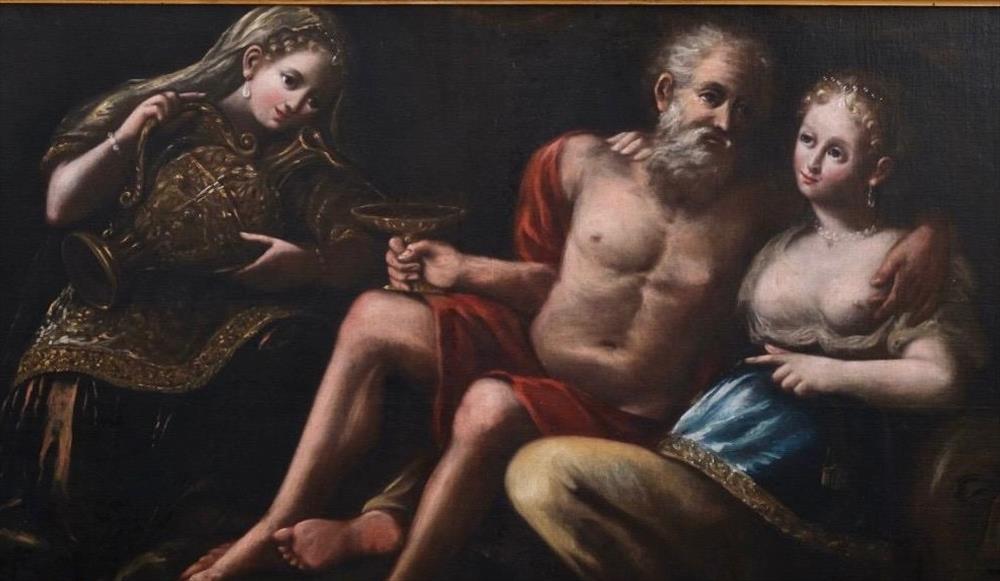
Lot sits half-naked, his body marked by age and already unsteady. He holds the cup, but his grip is uncertain. The two daughters build the scene around him: one pours the wine, the other supports him and directs his gesture. There is no violent movement, but a continuous, controlled tension.
The composition rests on a precise point: the cup.
It is where the hands meet, and where the situation takes shape.
The painting works through clear contrasts: the worn skin of Lot against the firmer flesh of the two women, the unstable posture against the firmness of their actions, the destruction in the background against what must continue in the foreground.
Light connects the two levels without theatrical effects. It moves softly across the bodies, brings out the reds and blues, and leaves the background in shadow without closing it off.
Details are handled with the same clarity. The gold embroidery catches the light, the drapery follows the movement of the figures, and the cup remains constantly visible.
From a stylistic point of view, the work belongs to Italian Baroque painting of the first half of the 17th century, with connections to Bolognese classicism and central Italian traditions between Bologna, Rome and Tuscany. The figures are constructed with balance rather than dramatic excess, maintaining a strong physical presence.
The scale is a defining element.
At 120 × 220 cm, this is a large-format painting conceived for an important interior, where it is meant to hold an entire wall.
Condition: the painted surface is overall legible, with age-consistent wear.
It is a closed scene, built entirely between the figures.
It reads directly.
Nothing else is needed.
- Material: Oil on canvas
- Size: cm 220 x 120
- Condition: Restored
- Period: 17th century
- Style: Baroque
- State: Good conditions