it
it
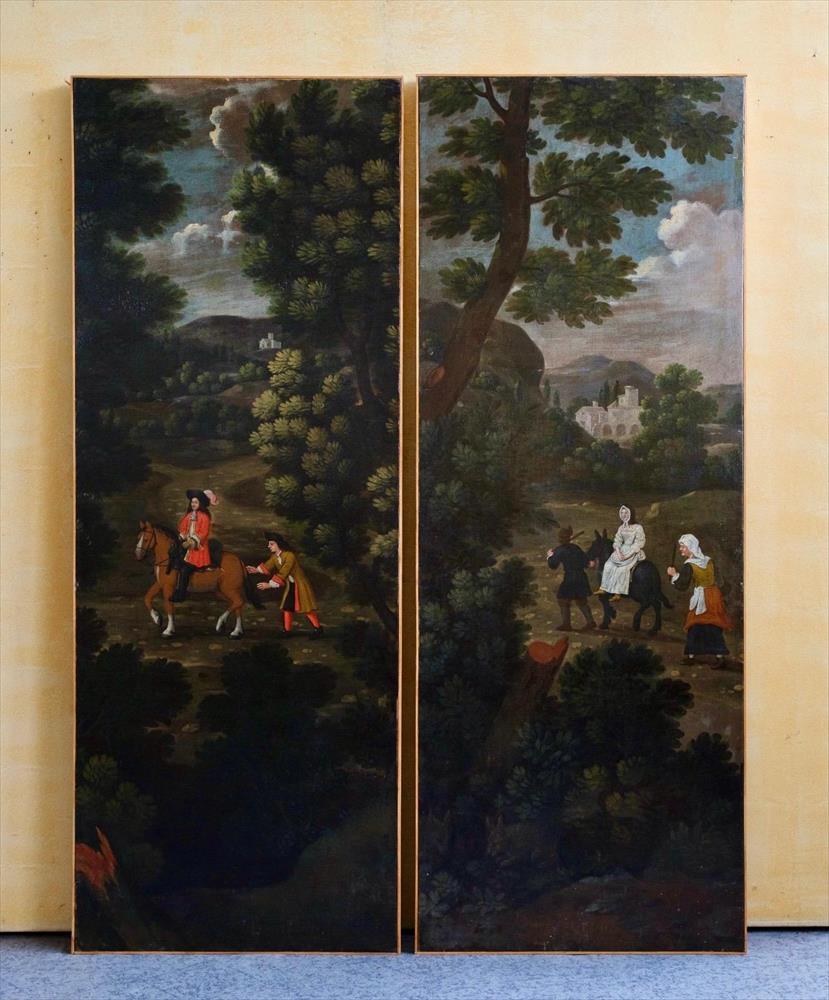
Tall, narrow, and clearly conceived for a specific setting.
These two oil on canvas panels (75 × 200 cm each) were not intended as independent easel paintings, but as architectural elements. In Venetian interiors of the late 17th and early 18th century, works of this format were designed to occupy vertical wall sections — between doors, windows or structural divisions — where painting would guide the eye and structure the space.
The two compositions are balanced through contrast.
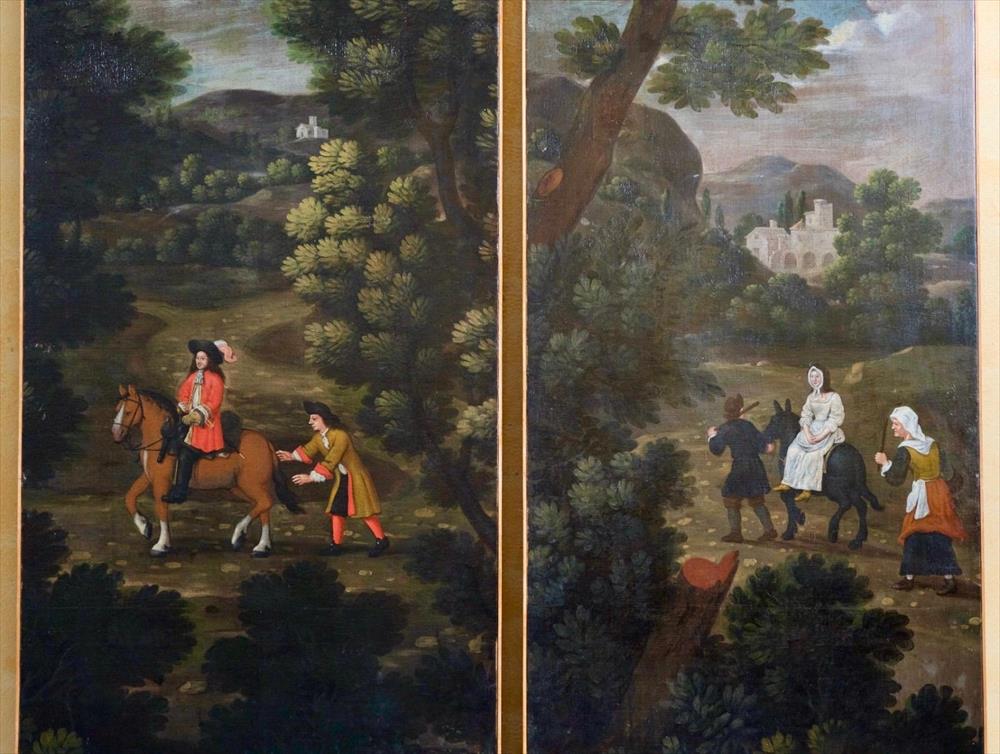
In one panel, a rider in a red coat advances on horseback, accompanied by a servant on foot. The figure carries a more formal presence.
In the other, the tone shifts: a woman dressed in light tones rides a donkey, led by a man and followed by an older female figure. The pace is slower, more grounded.
There is no continuous narrative, but a deliberate relationship between the two scenes. The red of the rider and the light tones of the female figure act as visual anchors, holding the pair together even at a distance.
The landscape is carefully organised.
Tree masses frame the sides like stage wings, while paths guide the eye inward. In the distance, small architectural elements — a church, rural buildings — establish depth without interrupting the flow.
This is not a depiction of a specific place, but a constructed setting, designed to create continuity within an interior.
The brushwork, particularly in the foliage, is concise and compact: short, clustered strokes build volumes of light rather than describing individual details. This approach is characteristic of Venetian landscape painting between the late 17th and early 18th century.
The clothing of the figures — the long coat, hairstyles and proportions — supports a dating between the late 1600s and the early decades of the 1700s.
The second composition, with a woman riding a donkey and accompanied along a path, also echoes visual schemes found in religious imagery associated with journeys. Here, however, the subject remains open, contributing to the suspended, narrative quality of the scene.
Stylistically, the works belong to the Venetian landscape tradition, in the orbit of Marco Ricci and later developments associated with Giuseppe Zais.
The painted surface is stable and clearly legible, with well-preserved colour.
A pair conceived to structure space through vertical movement, still capable of performing that role today.
- Material: Oil on canvas
- Size: cm 75 x 200 h
- Condition: Restored
- Period: Early 18th century
- Style: Louis XIV
- State: Optimal conditions