it
it
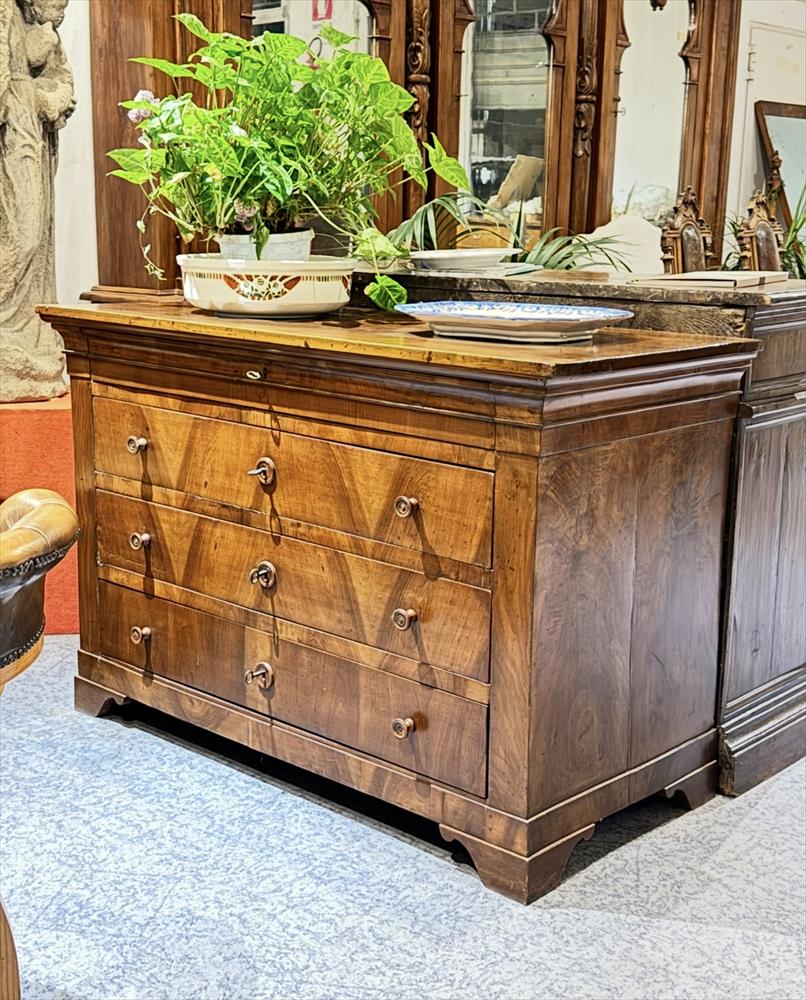
“Cappuccino” Walnut Chest of Drawers, Early 19th Century
A chest of drawers from the Restoration period, the transitional phase between the strict, geometric forms of the Empire style and the softer elegance of early Louis-Philippe. Its lines are clean and balanced, designed to highlight the quality of the wood and the precision of its construction.
Made entirely of solid walnut, it features a veneered front with vertical grain arranged to create a symmetrical pattern, and solid-walnut sides with feather-like figuring—a combination that immediately reveals the careful selection of the timber. The internal frames and drawer linings are also in solid walnut, an uncommon detail that speaks to a skilled workshop and a client who was not seeking economical solutions.
The piece rests on cartella feet, while the upper drawer is integrated into the slightly projecting and gently flared top apron—an identifying feature of Piedmontese furniture known colloquially as the “cappuccino” model.
Originally intended for the bedroom of an elegant household, it would likely have been paired with a sleigh bed, cylindrical bedside tables, and a gilded mirror positioned above the fireplace. A room lit by candles or oil lamps, with the quiet, intimate atmosphere typical of early 19th-century interiors.
Beautifully preserved and completely original, it is ready for use: carefully restored, stabilised, treated against pests, cleaned, sanitised, and finished with a shellac and wax polish.
Its solid construction, harmonious proportions, and surprisingly modern linearity make this chest of drawers a versatile piece—equally suited to a bedroom or a contemporary living space, where it creates a harmonious contrast, brings warmth and character, and pairs effortlessly with modern furnishings without losing its identity.
A piece whose quality is immediately evident, even to the untrained eye.
- Material: Solid walnut wood with veneered sections
- Size: cm 137 x 62 x 91 (H)
- Condition: Restored
- Period: Early 19th
- Style: early 19th-century Restoration period
- State: Optimal conditions